
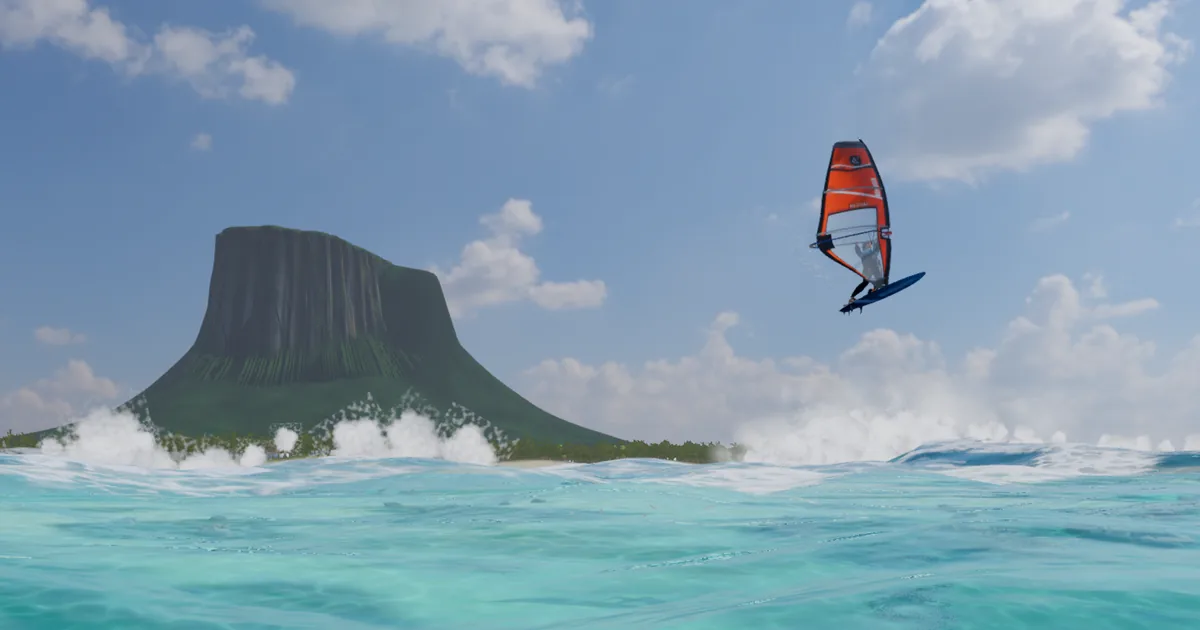
A seventh spot in Mauritius, wave jumps that go almost straight up, and riders who stand like the ones in real videos. After my first article about WindRush and the October 14 update on real skies and La Palme, here is what came next. In three days the game gained Le Morne, its lagoon and the One Eye wave, along with new manoeuvres, a real race atmosphere and stances corrected from real footage. Here is what changed, how I work with Claude, and what is still not right.
This update in numbers
Le Morne, a spot like no other
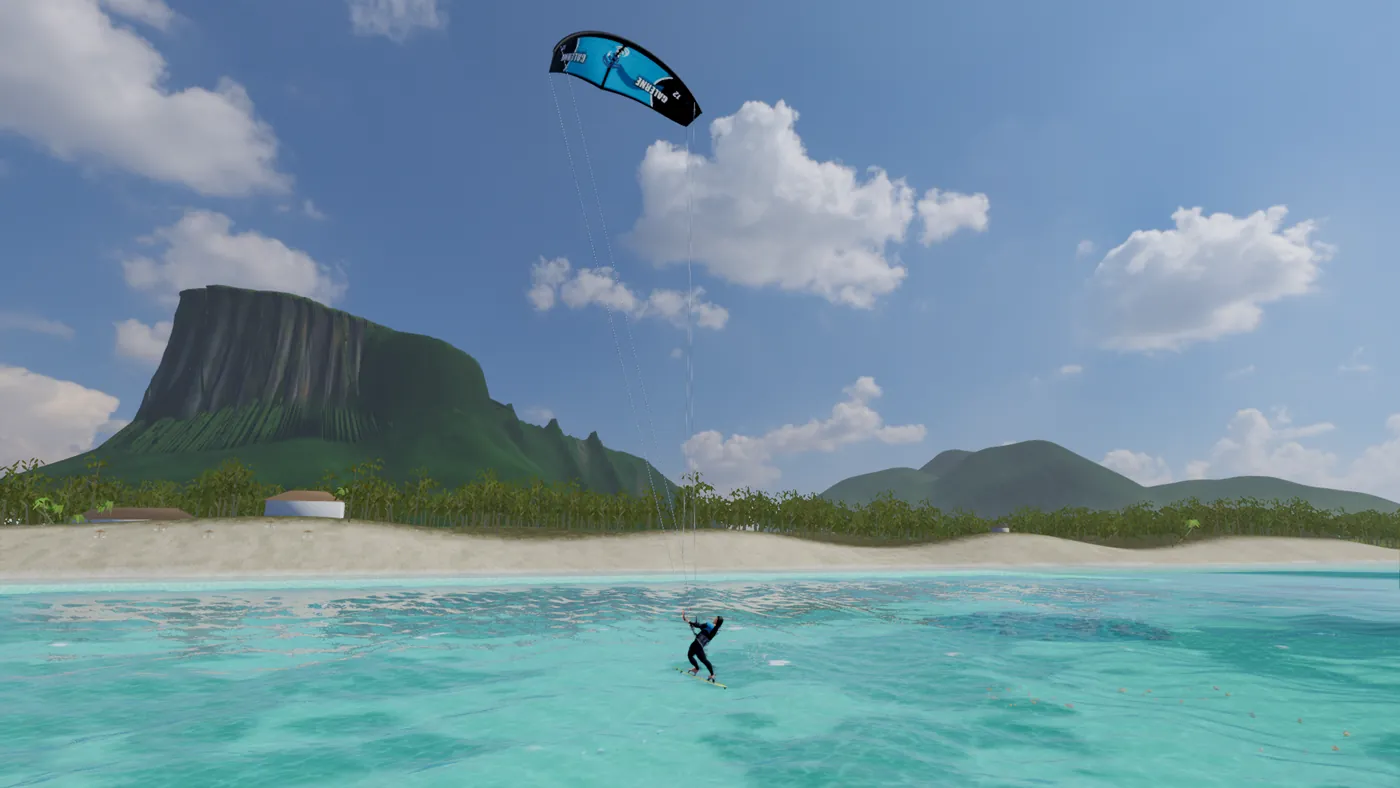
Le Morne Brabant is a 556-metre basalt mountain at the south-west tip of Mauritius. It is a World Heritage site and a symbol of the fight against slavery. At its foot lies a large turquoise lagoon, sheltered by the coral reef. The south-east trade wind blows mostly from May to November, and out on the reef breaks One Eye, a famous left.
What you will find at Le Morne
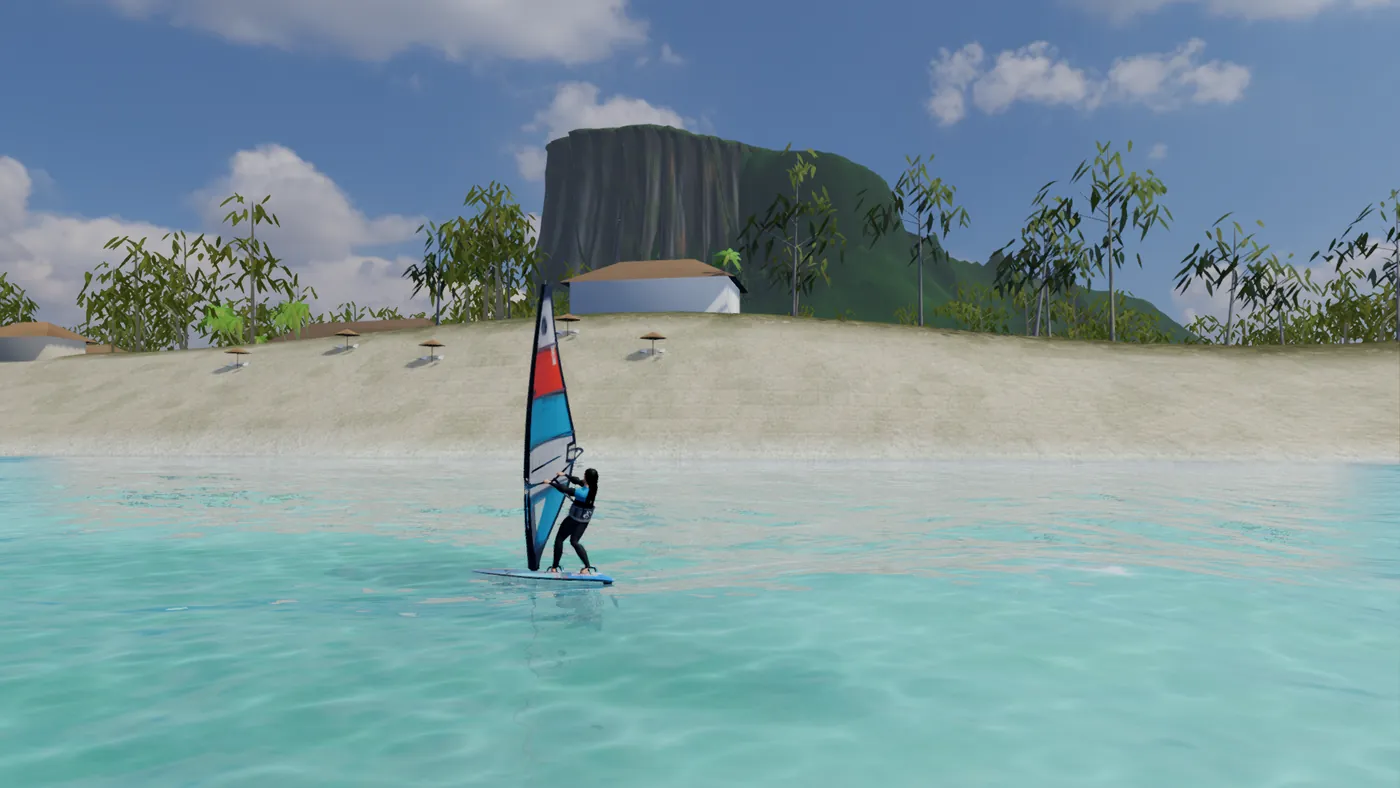
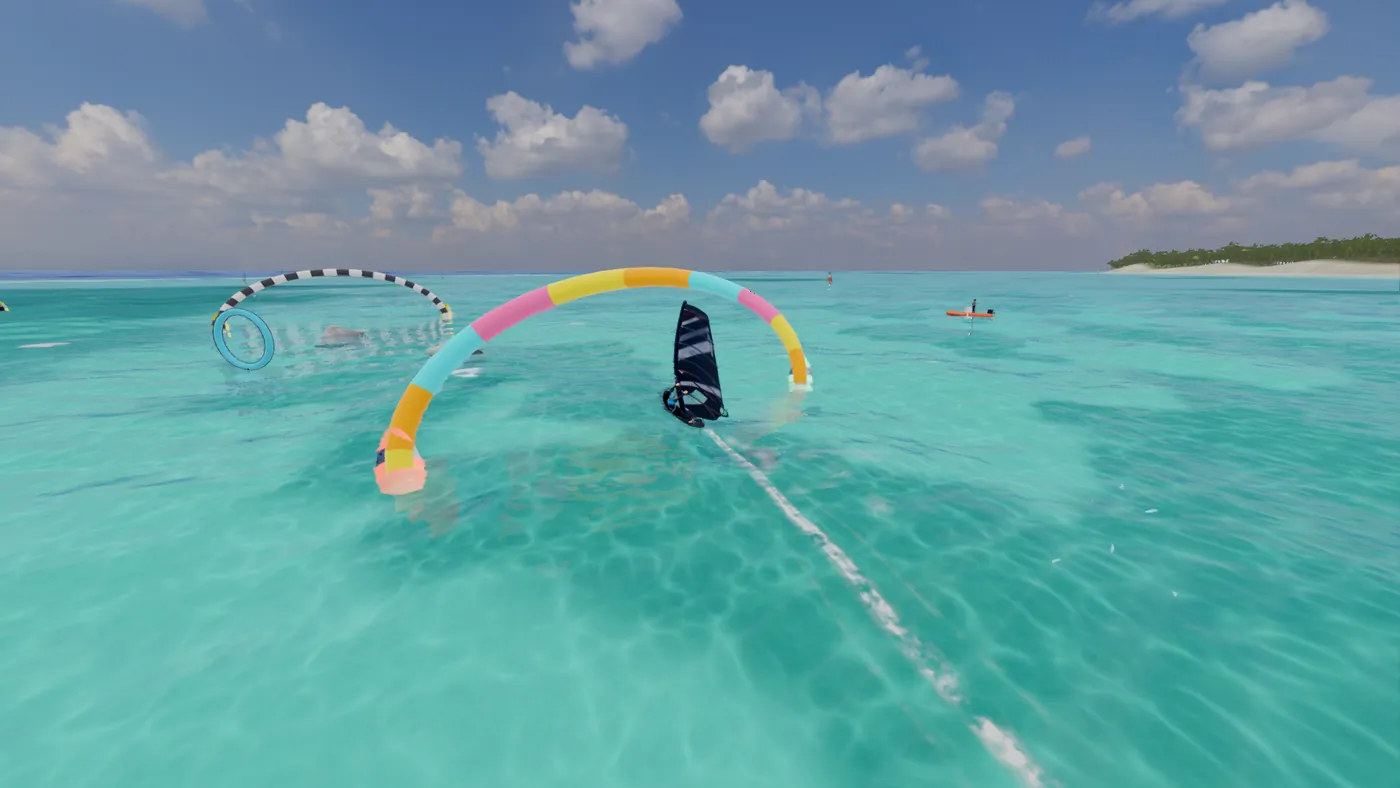
- The lagoon: 1.5 to 2 metres of turquoise water, round and crisp coral heads, darker seagrass beds and a clear lane for the race course.
- The beach: warm coral sand, about 2,250 casuarina trees (the island's filaos) moving in the wind, a few coconut palms, and the thatched roofs of low hotels hidden among the trees.
- The mountain: almost vertical dark basalt walls and green ledges. The sun sets behind it.
- The reef: the One Eye left, hollower than the other waves, and six reef heads sticking out of the water. Hit one and you fall, just like the lava spires at Ho'okipa.
- The weather: an east-south-east trade wind at 22 knots, a lighter morning, and a tropical squall at 30 knots.
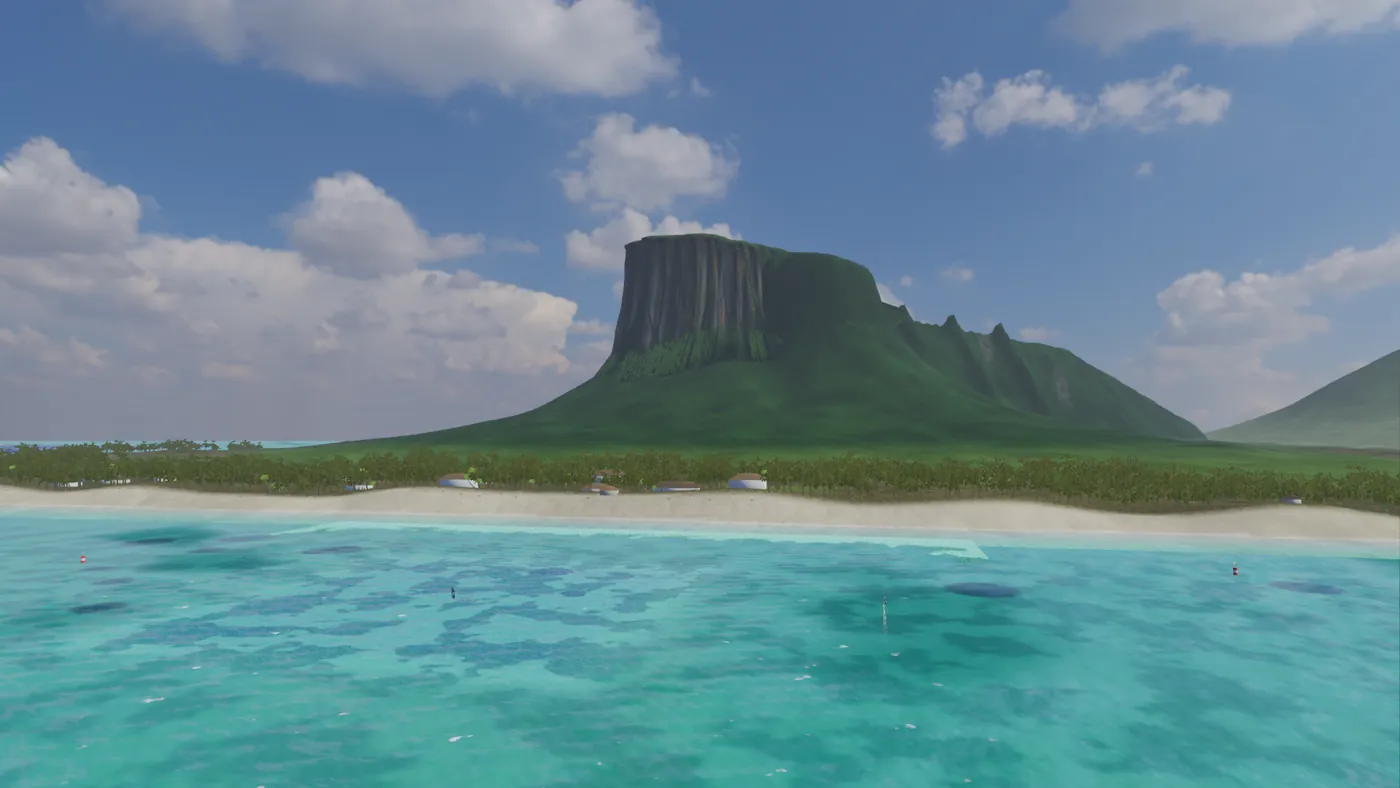
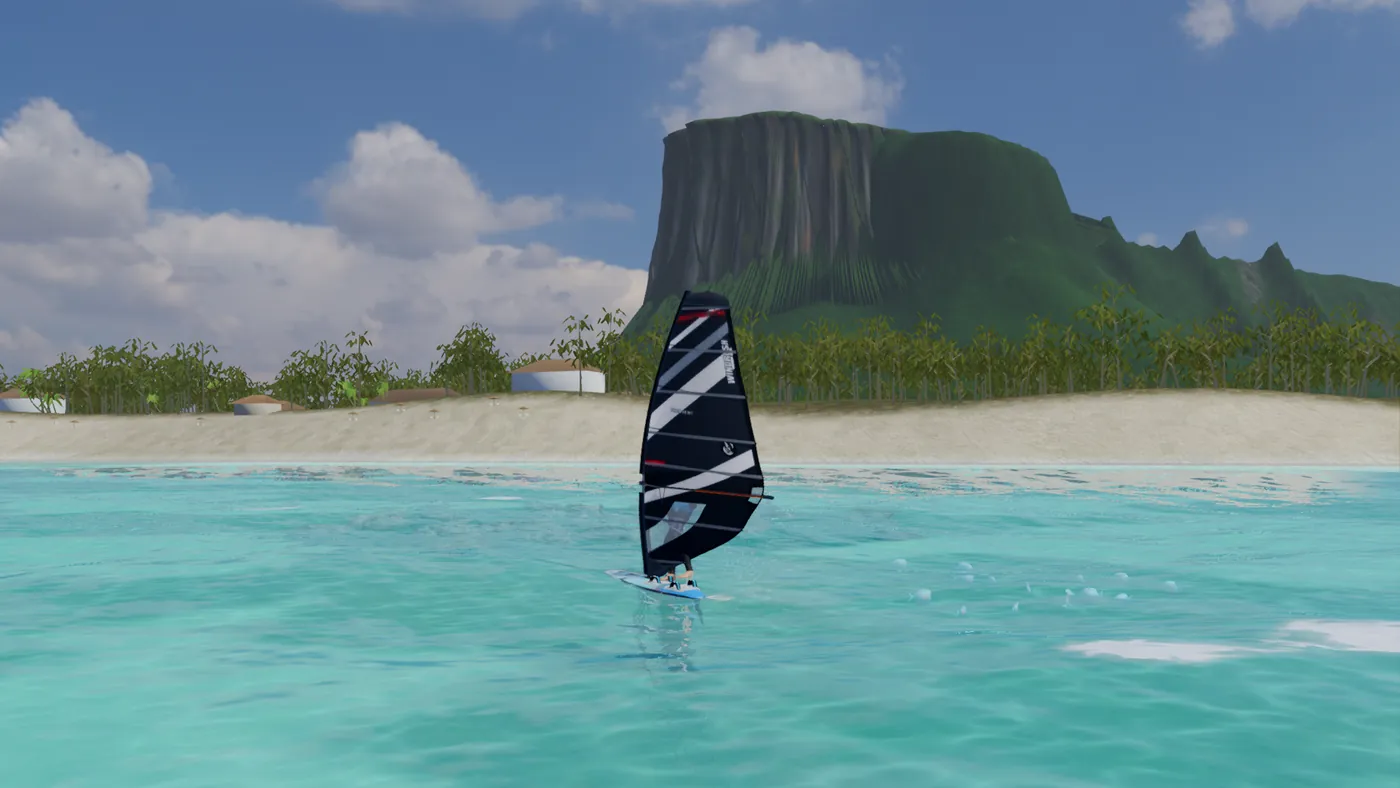
In the game: races in the lagoon with the race atmosphere, a "Lagoon tour" time trial and a new career chapter, chapter 6, with 5 stages: wing flight, kite jump, slalom, wave jump and a wave trick in the squall. In free mode, Le Morne unlocks at level 12. I chose to place it right after Lagoa, without blocking access to the Final.
Vertical jumps off the waves
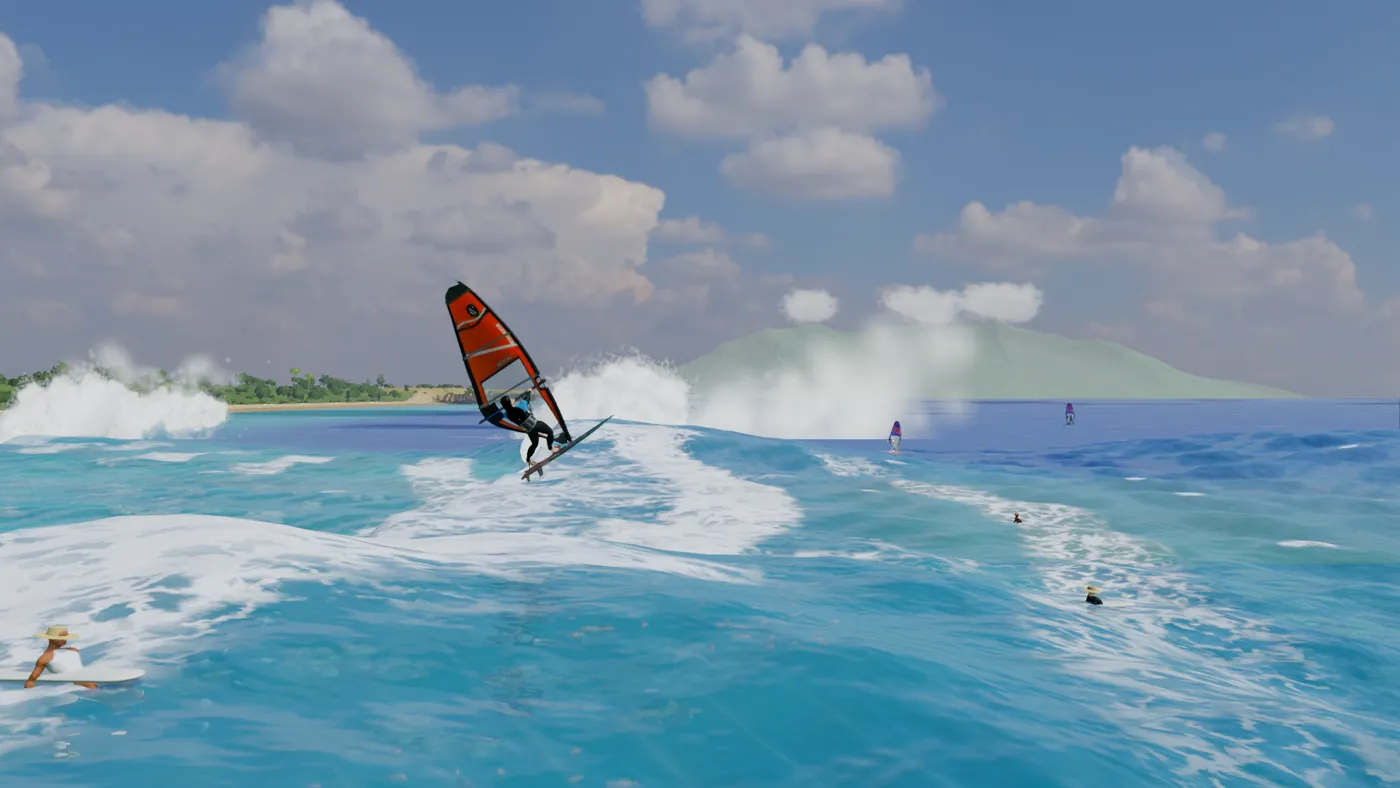
Wave jumps used to be long and rather flat. Now, as in real life, a steep, hollow face and a perfect pop at the lip send you up almost vertically, at 55 to 68° depending on the wave. A small, soft wave still gives the old long, flat jump.
The measurements, before and after, windsurfing a big wave at Ho'okipa: the take-off angle goes from 62-64° to 68°, the height above the lip from 2.8-4.4 m to 3.4-4.5 m, and the jump length drops from 9-13 m to 7-9 m: you go higher and less far. On a small wave, the jump leaves at 46-48° and climbs about 2 metres, where it often did not take off at all before. At One Eye, one measured perfect jump: face at 58°, a 3.3 m wave, take-off at 68°.
As in the reference video, the board pitches up within limits and lands tail first. The panel shows "VERTICAL JUMP", and the score rewards verticality: 100 points per metre of height, up to a 40% bonus for a truly vertical jump, plus 6 points per metre of length.
Stances taken from real footage
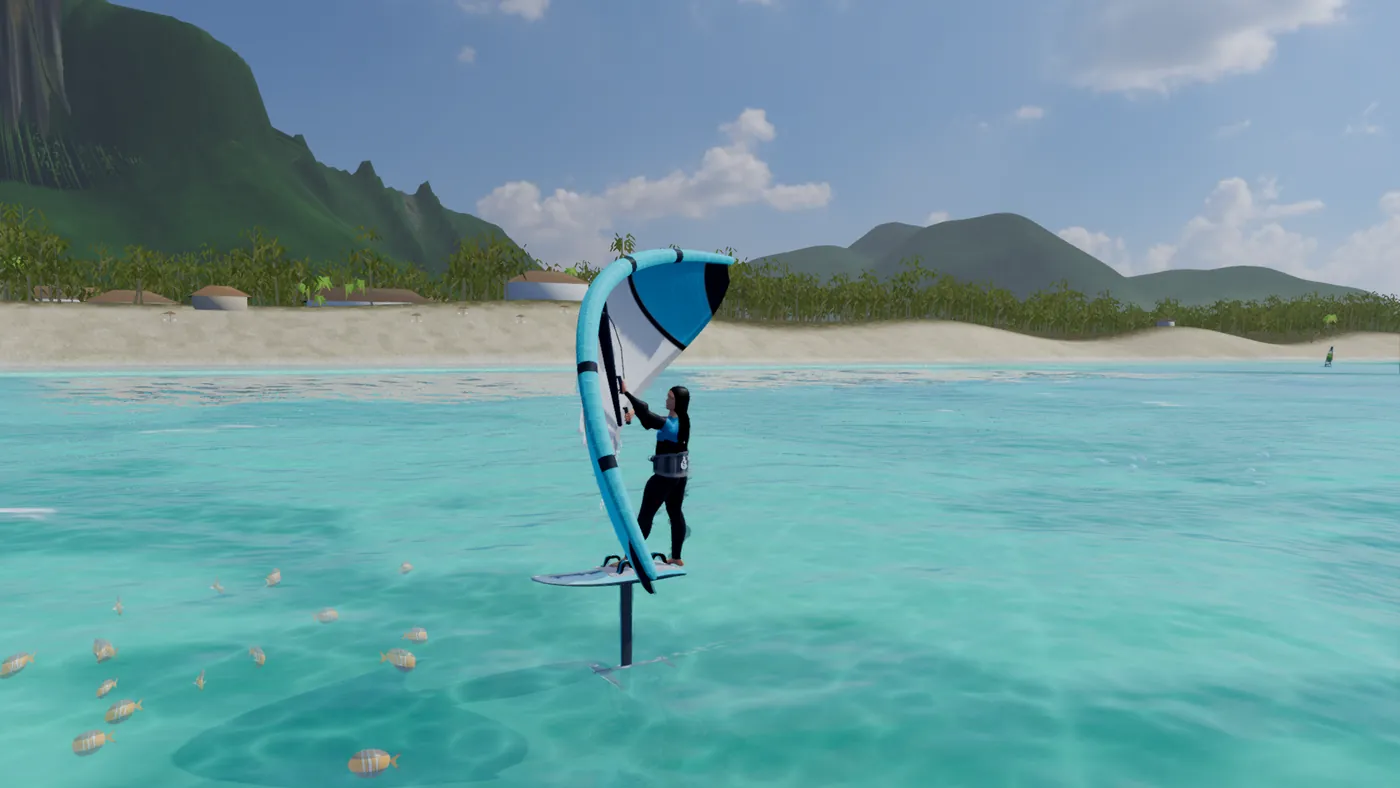
- Wing: the wing is now held about 0.9 m in front of the chest, with the canopy away from the body, as in my photos. PoseTest measurements at 22 knots on a beam reach: wing in front of the chest from 0.58 to 0.87 m, lowest wingtip above the water (worst frame) from 0.10 to 0.70 m, and the gap between chest or head and the canopy from 0.27 to 0.41 m.
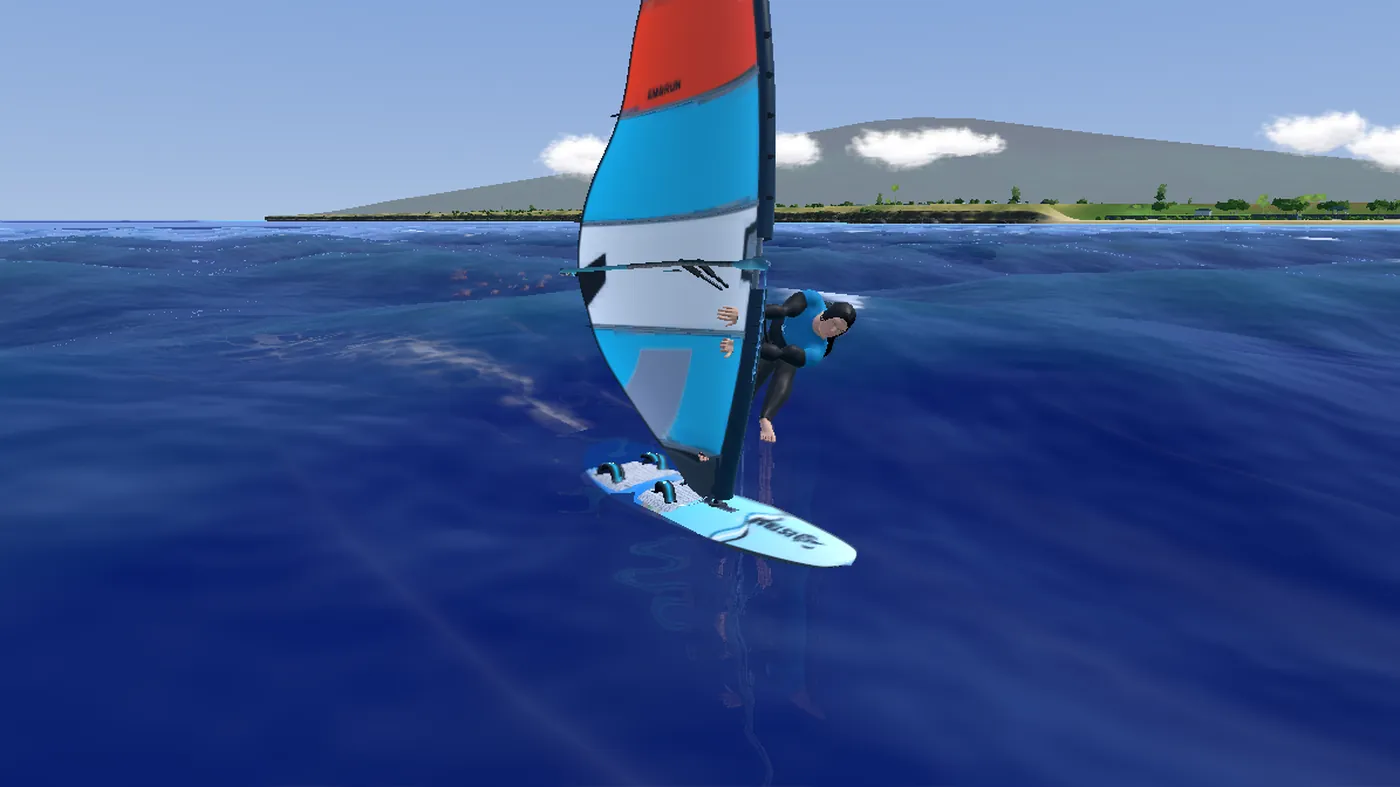
- Windsurfing in waves: on the face, the mast leans further towards the rider and the upper body leans out more. At the top of a vertical jump, the rig lies back up to about 45°, with the rider hanging under the boom.
- Kite: in a real jump, the kite goes up overhead and the bar comes back to the chest.
New manoeuvres
On October 14 I listed them as next steps. They are now in the game:
- The tack (V key, B button on a gamepad): upwind, the rider steps around the front of the mast and changes tack, as in real life. You need a bit of speed: too slow and the board stalls head to wind and you fall in. For now, finned boards only.
- Uphauling the sail: in light wind (under 11 knots), after a fall, the rider climbs onto the board and pulls the sail out of the water with the uphaul, hand over hand. Between 11 and 14 knots, you choose: uphaul or waterstart.
- The kneeling wing start: the wing, lying upside down on the water, is flipped over and lifted overhead, then the rider stands up.
- The kite waterstart after a fall: sitting in the water, board on your feet, kite overhead; one key dives the kite, the pull lifts you up and you are off.
A real race atmosphere
Near the start and finish of every course, and on the La Palme speed run, there is now a race village: flags flapping in the game's real wind (direction, strength and gusts), strings of light bulbs that switch on at sunset, tents, a judges' tower and a safety RIB moored near the finish. The crowd, dressed for the wind, follows the riders with their eyes, films on their phones, points and cheers every finisher, you and your rivals alike. In freeride, none of that: the beach stays quiet.
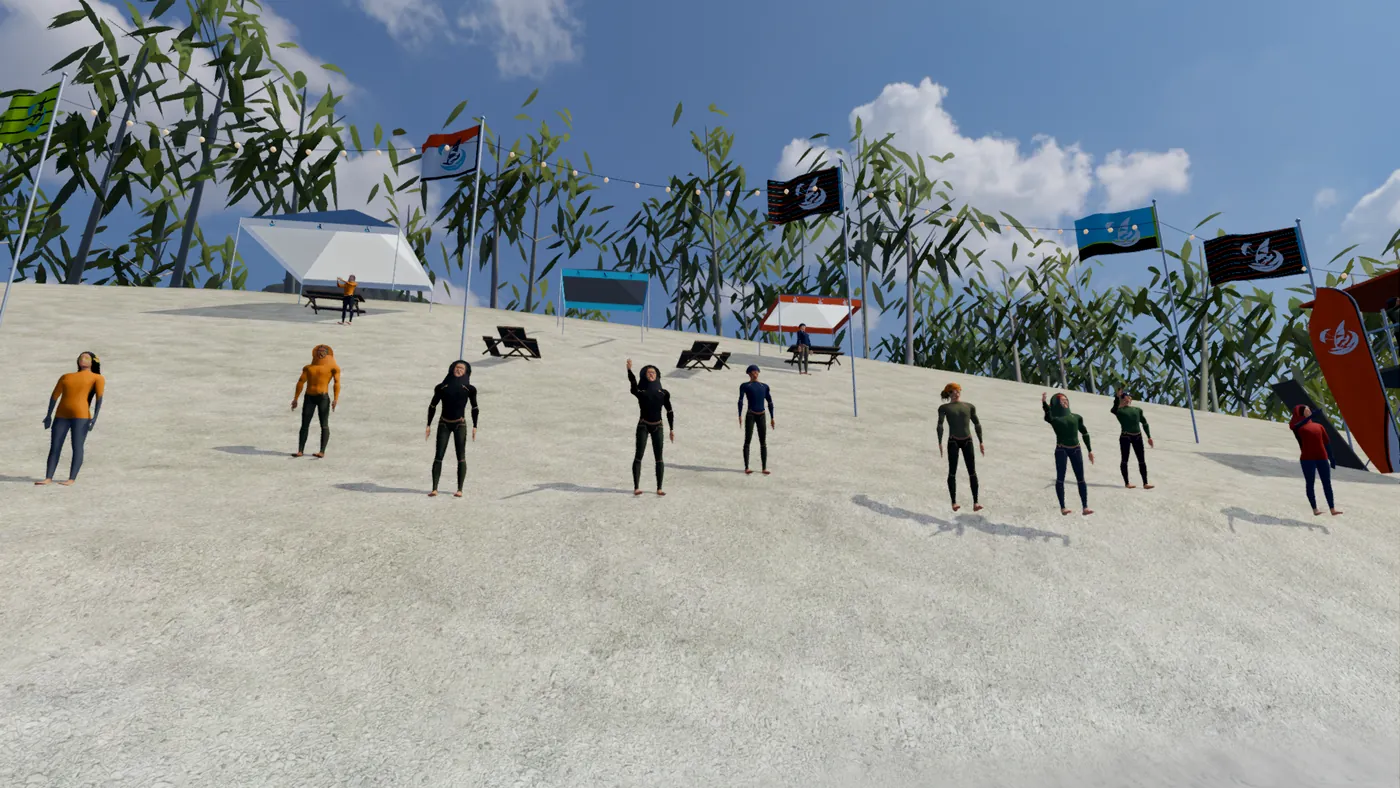
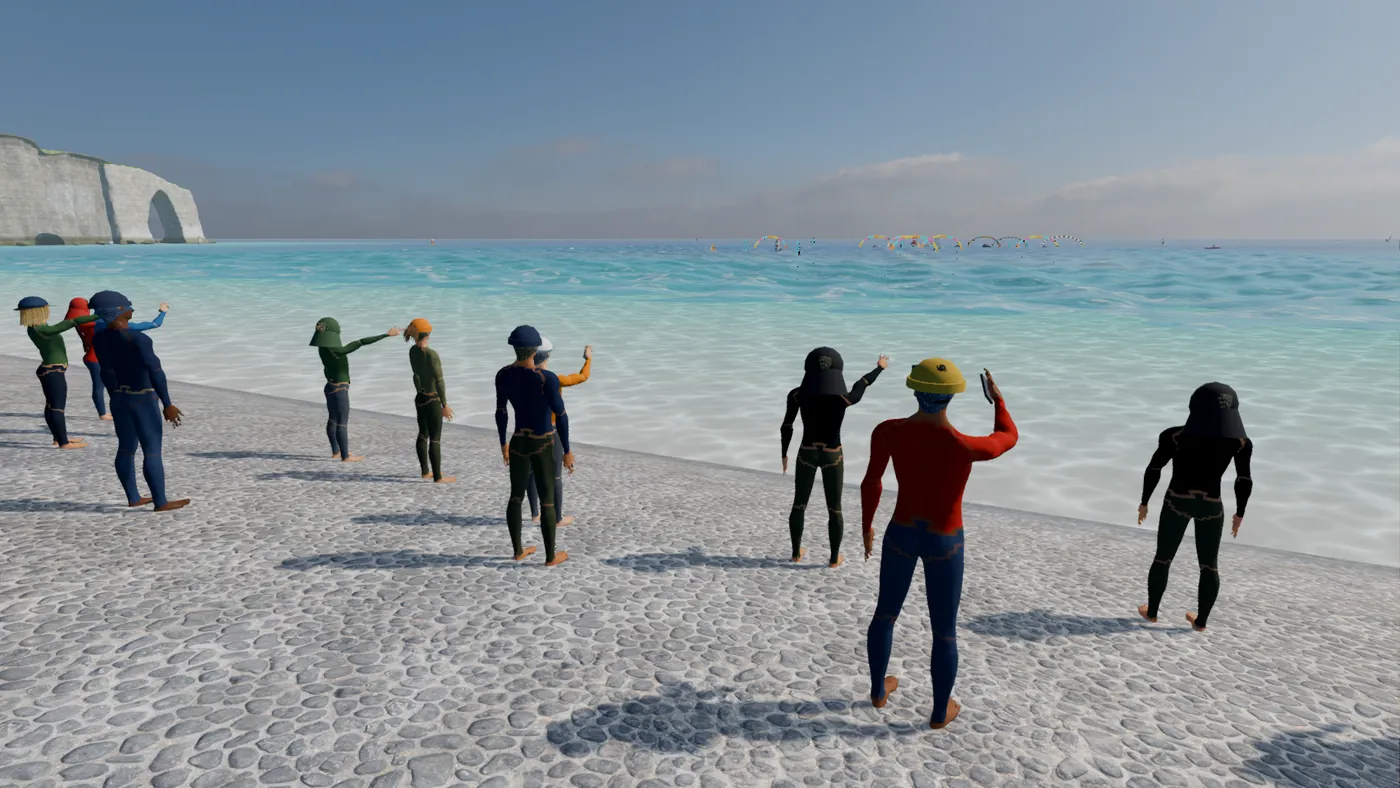
Photo-textured scenery and livelier hair
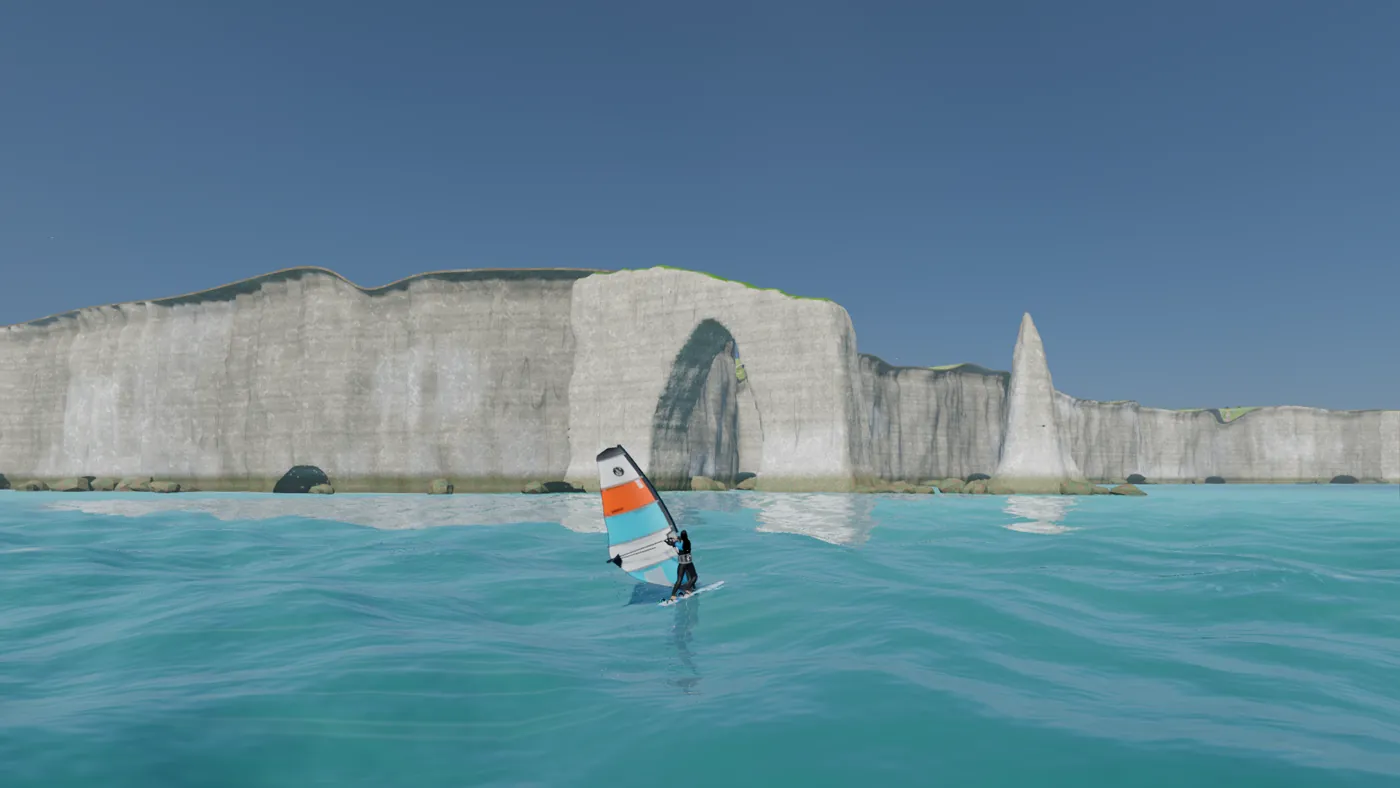
At Ho'okipa, the lava rocks and the sea wall now use photo textures: every stone in the wall has its own photo, joints and mortar. The distant hills of several spots, and the fields on top of the Étretat cliffs, use aerial photos at two scales, out to 4.5 km.
Hair has also gained fine strands, and the tips of long hair swing more when the rider goes fast.
Quality and performance
An automated endurance test played the exported game through more than 300 transitions in a row: races, La Palme, tacks, falls and uphauls, the shop and the options. Result: every run ended with exit code 0, with no exceptions and no freezes. At Le Morne, on a laptop with integrated graphics, in the editor and in High quality, I measure about 36 frames per second in freeride, with peak memory of 2.1 to 2.4 GB. Light mode is still there for more modest PCs.
Behind the scenes
- References: I provided my own photos and online videos I picked. Claude analysed them frame by frame, without downloading them, to pull out angles and distances: how high the wing is held, how a jump takes off, how the rig lies back. For the gear, a surf shop's photo catalogue serves as a reference for shapes and proportions.
- PoseTest, the automatic pose test, puts the 3D rider in precise situations, measures angles and distances and flags every failure. Every fix goes through it, and the rules get stricter when a stance improves: in wing, the wing now has to be at least 0.80 m in front of the chest.
- Several Claude agents in parallel: separate sessions each work on their own lot (scenery, stances, quality, Le Morne, the website), each with a limited budget of actions. Each lot keeps a copy of the previous version, a before and after board, and a list of what is left to do.
- I decide and check: the priorities, where Le Morne fits in the career, and what looks "real" or not. Settings that affect the feel, like the slalom stance, wait for my call.
What still needs work
Let's be honest: up close, the casuarinas are still not bushy enough. The reef can be crossed outside the six reef heads. The slalom stance has not been retouched yet: the videos show a less raked mast and a more bent back leg, and the decision is mine to make. In wing, from some angles, the canopy still covers part of the body. The game has been tested on few PCs, and it is only available in English, French and Spanish.
If your PC is different from mine, your feedback really helps: smoothness, crashes, feel.
Download WindRush
WindRush is free for Windows PC on jstephan.itch.io/windrush, and also as a direct download from www.windrush.fr. Take a trip to Le Morne, try a vertical jump at One Eye, and tell me what you think.
I use the same approach (C#, .NET and AI as a copilot) on client projects: applications, platforms and games. See my custom software development service, or the case study of the FamiQuiz multiplayer game in .NET (in Spanish).
Got an app, platform or game project?
Let's talk: I'll propose the architecture, the timeline and a clear price.
Get my free quoteMessage me on WhatsApp