
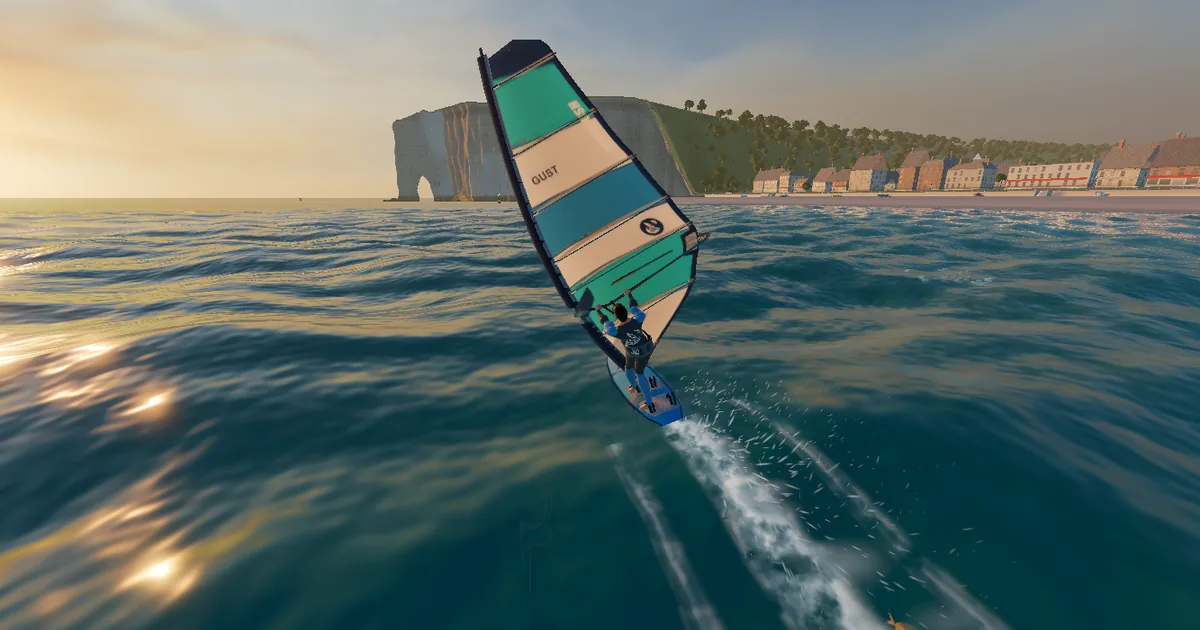
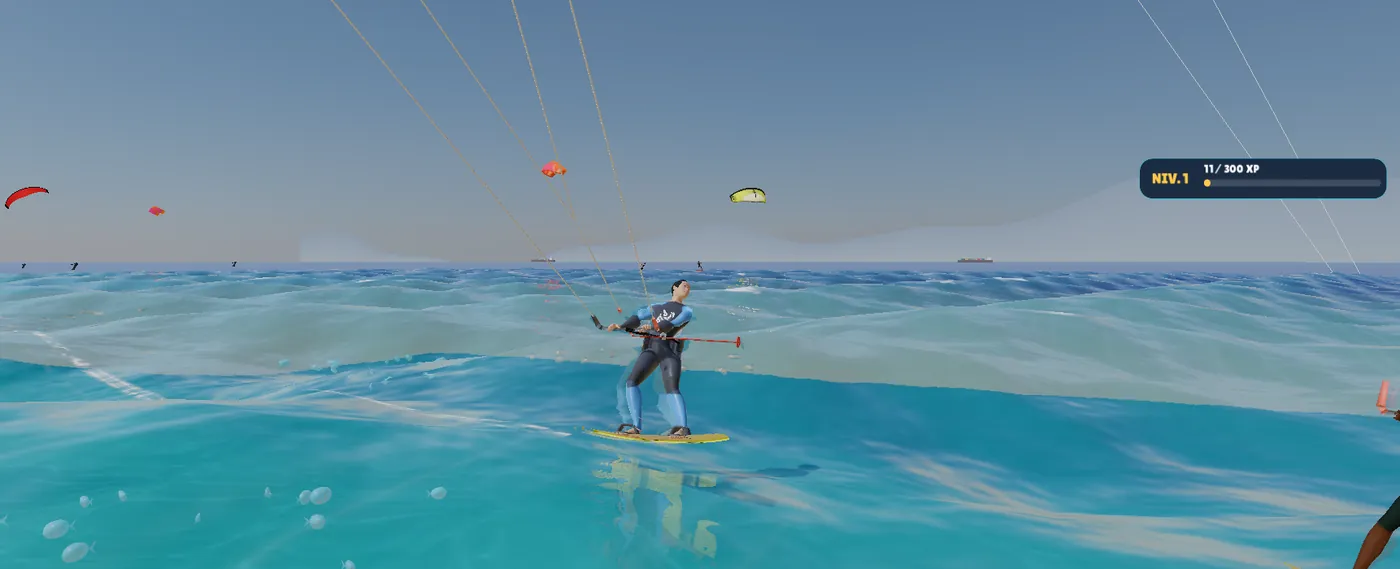
A free PC game, photographic skies, a new speed spot and riders that finally hold the boom properly. Since my first article about WindRush, the game has moved fast. Here is what changed between October 10 and 14, what Claude Code did, what I decided, and what still needs work. Every image is a screenshot of today's build, in High quality.
The week in numbers
A clear choice: a real PC game
I had prepared a version for Android phones. I dropped it: on mobile, memory and the simplified renderer were holding back the realism. WindRush is now a free game for Windows PC, on itch.io and as a direct download from www.windrush.fr (a 149 MB zip).
That choice opened the door to Godot's full renderer (Forward+): reflections of the sky and scenery on the water, ambient occlusion and soft shadows. There are three quality levels, Low, High and Ultra (Windows PC only). And since not everyone has a powerful graphics card, there is a light mode: the first time the game starts on integrated graphics, it measures smoothness for a few seconds and, below 30 frames per second, offers once to switch to light mode. On my PC with integrated graphics, La Palme goes from 50.7 to 87.4 frames per second in light mode.
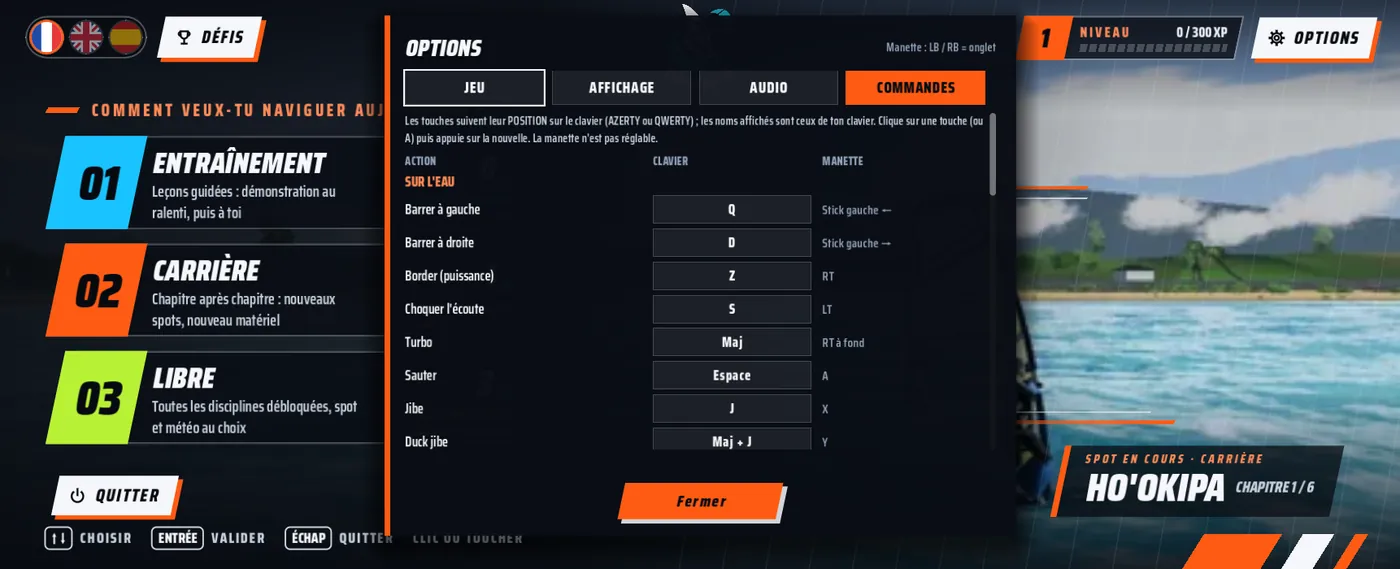
The rest of the PC work: tabbed options (Game, Display, Audio, Controls), fullscreen, windowed or borderless, frame rate cap, field of view from 55 to 90°, adjustable 3D resolution; 36 rebindable keyboard actions, shown with the real key names (a French AZERTY keyboard shows Z and Q where a QWERTY shows W and A); full gamepad support, menus included; F12 to save a screenshot in your Pictures folder; a Quit button; and the Windows language picked automatically if the game speaks it (English, French or Spanish).
Real photographic skies
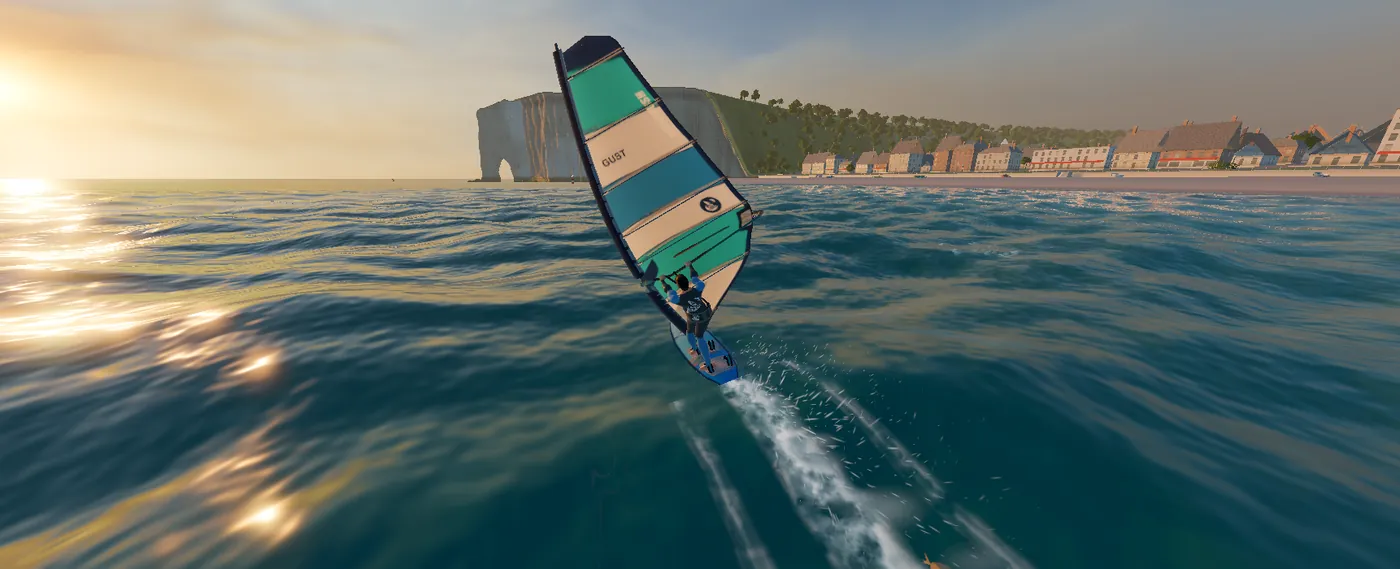
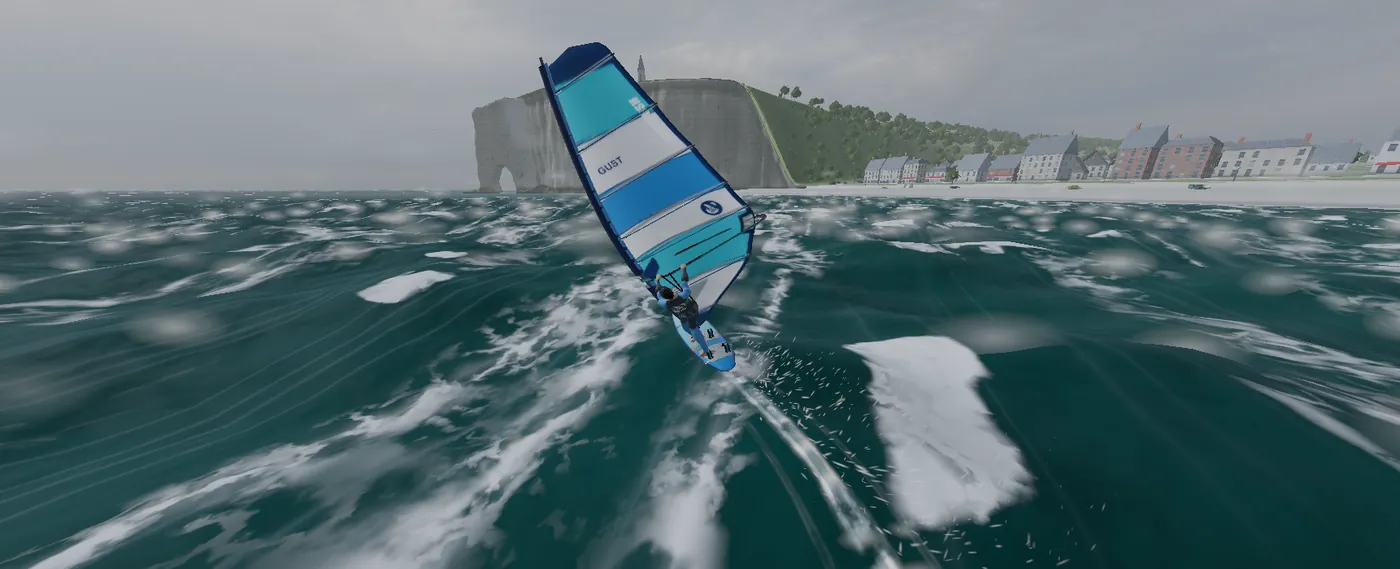
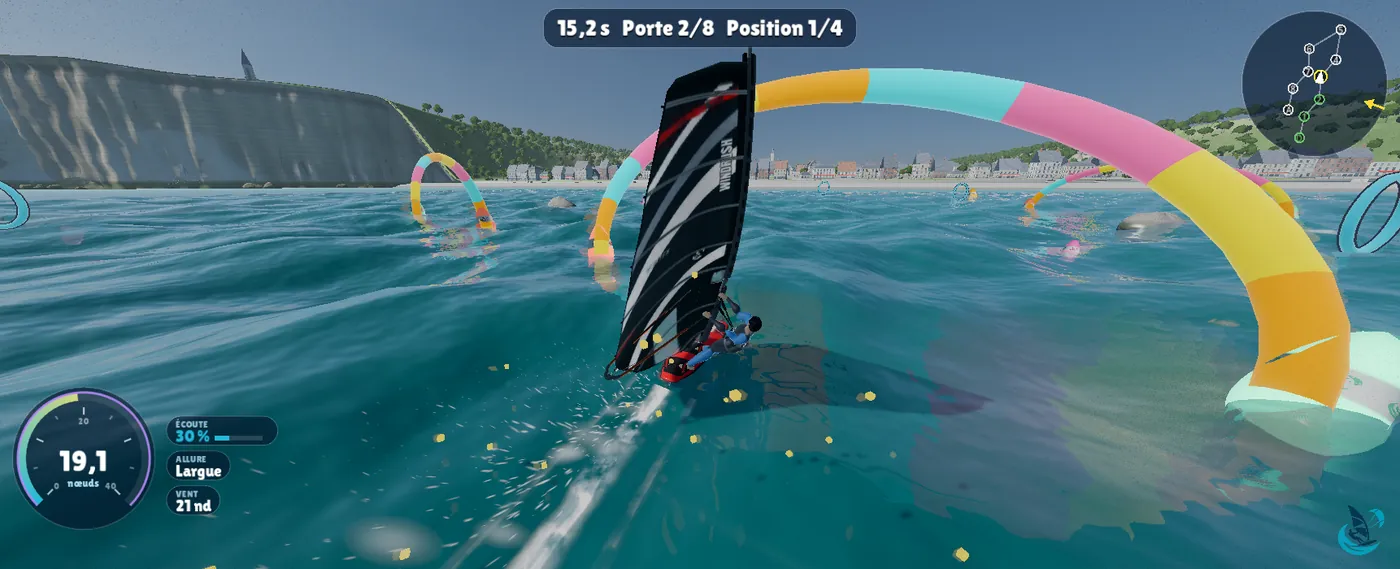
This is the most visible change. The painted skies gave way to 7 HDR panoramic photos from Poly Haven, under the CC0 license (free to use, checked one by one): clear or cloudy midday skies, morning, sunset and storm. Each photo is more than a backdrop: it lights the scene. The in-game sun sits exactly where it is in the photo, at the same height and with its colour, and the sky reflects on the water. Each sky takes 8 MB of video memory, and only one is loaded at a time.
With these skies, the sea had to keep up. Claude looked into why the water looked "milky": the pale sky was painted into the water colour and then lit like matte paint, the reflection was too strong for real water, and the red of the sand was not absorbed. The fix: one palette per spot, computed like real light absorption in water. Ho'okipa comes out Pacific blue offshore, Étretat deep blue green and jade near the chalk, Tarifa Atlantic blue, Jericoacoara emerald and Lagoa bright turquoise.
La Palme: 500 metres to break 100 km/h
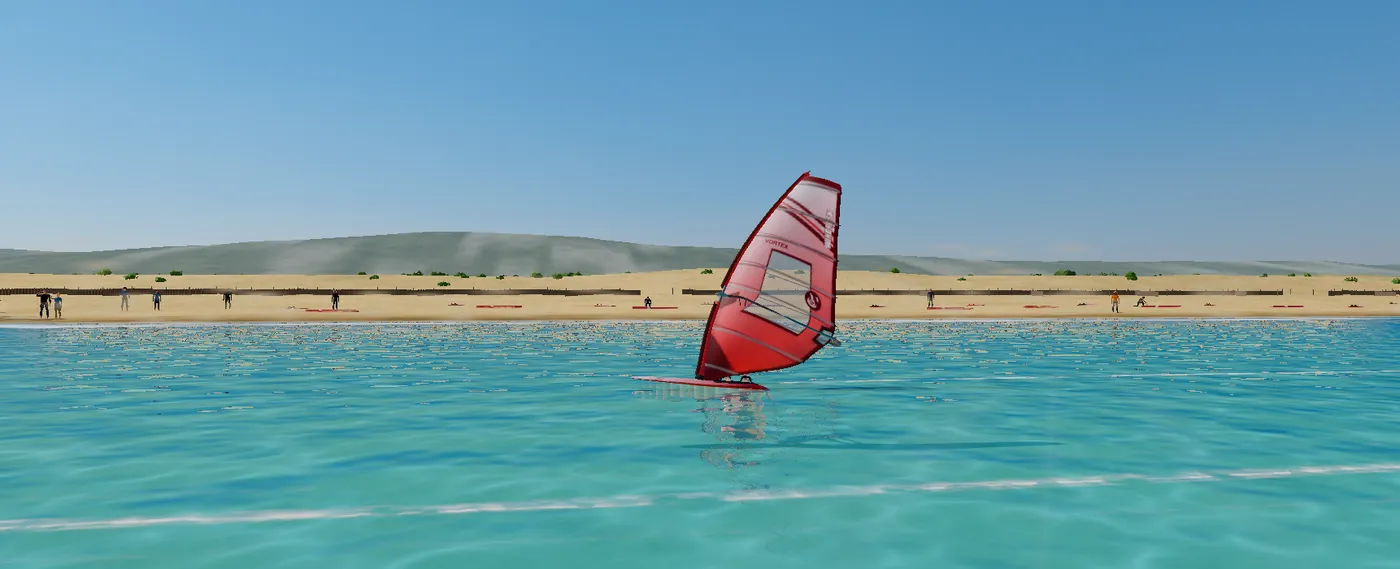
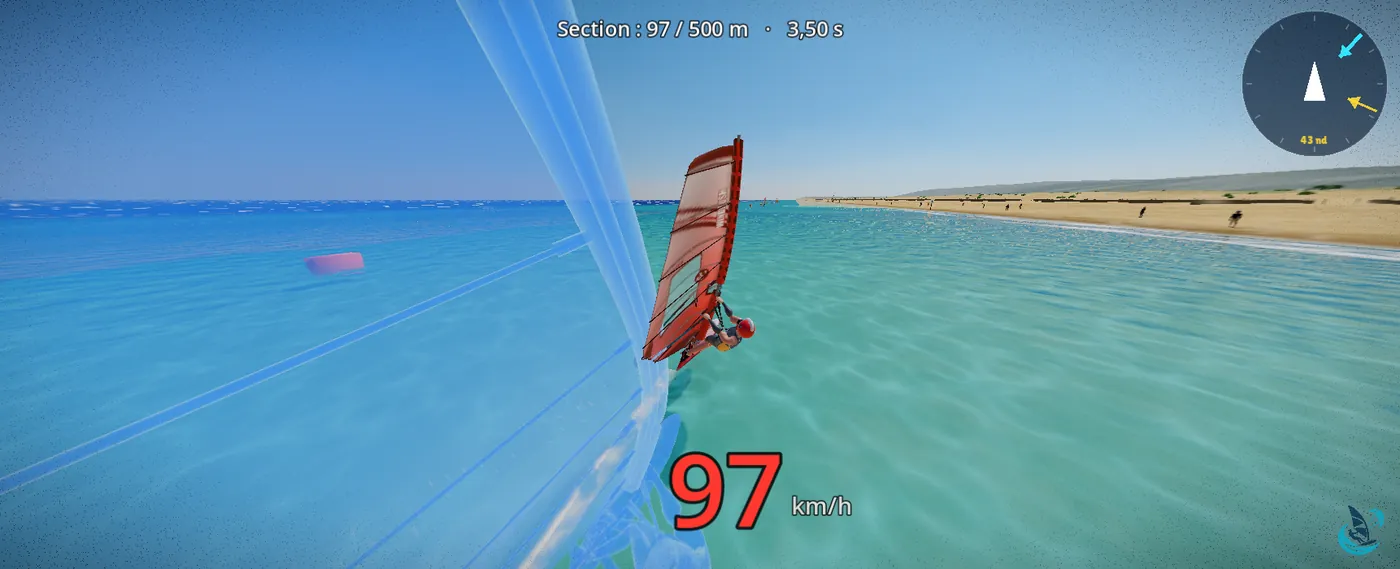
The speed spot is now a real place: the Plage du Rouet at La Palme, in the south of France. A 500 metre lane along the beach, 34 metres from the shore, in about 75 cm of water, with the Tramontane blowing offshore up to 40 knots. The water stays flat near the sand and gets choppy further out. Go too close to the shore and the board runs aground; go too far out and you leave the lane. All around: dunes, sand fences, the lagoon, the Port-la-Nouvelle breakwaters, buoys, start and finish gates, a timing tent, 44 spectators and five speed riders. On autopilot, a run averages 91.7 km/h with a top speed of 102.7 km/h.
Racing your own ghost
Every timed event (slalom, kite, foil and wing races, the La Palme run) now records your best run: position, gear and the rider's full pose, 20 times per second. When you play again, a translucent blue rider replays your record. The gap is shown at every gate or every 100 metres, in green when you are ahead and red when you are behind, and the finish announces a new record. It all fits in 150 KB for a La Palme run and 0.5 MB for a slalom of almost two minutes. A records and ghosts panel lets you review or delete them.
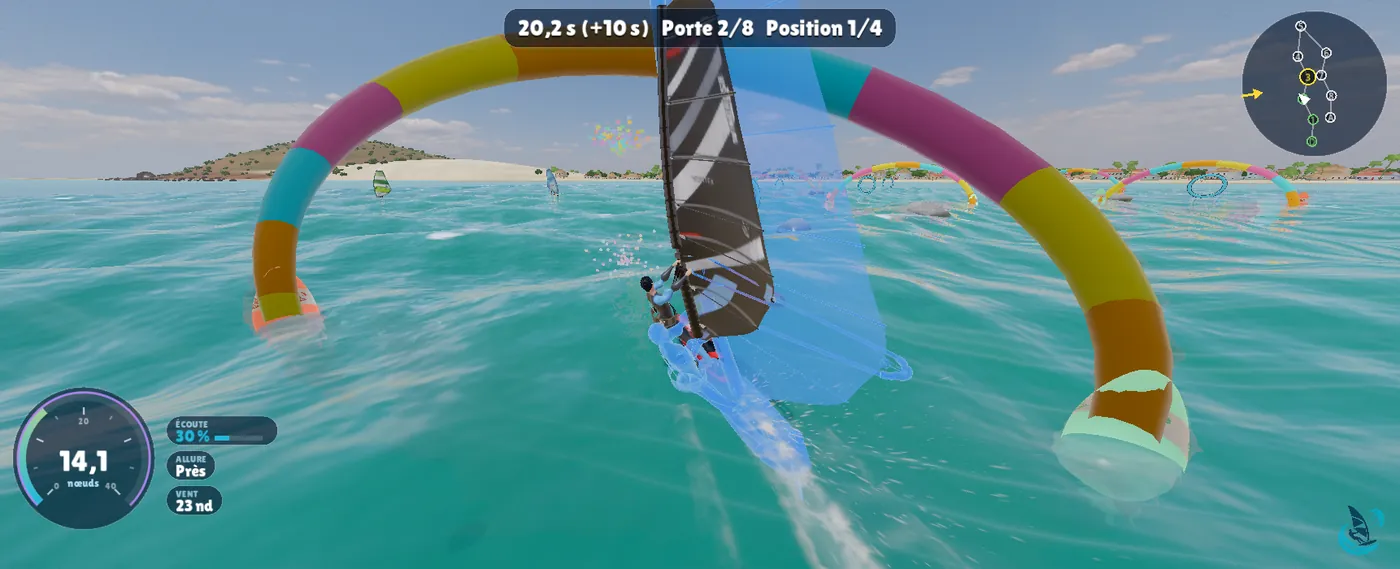
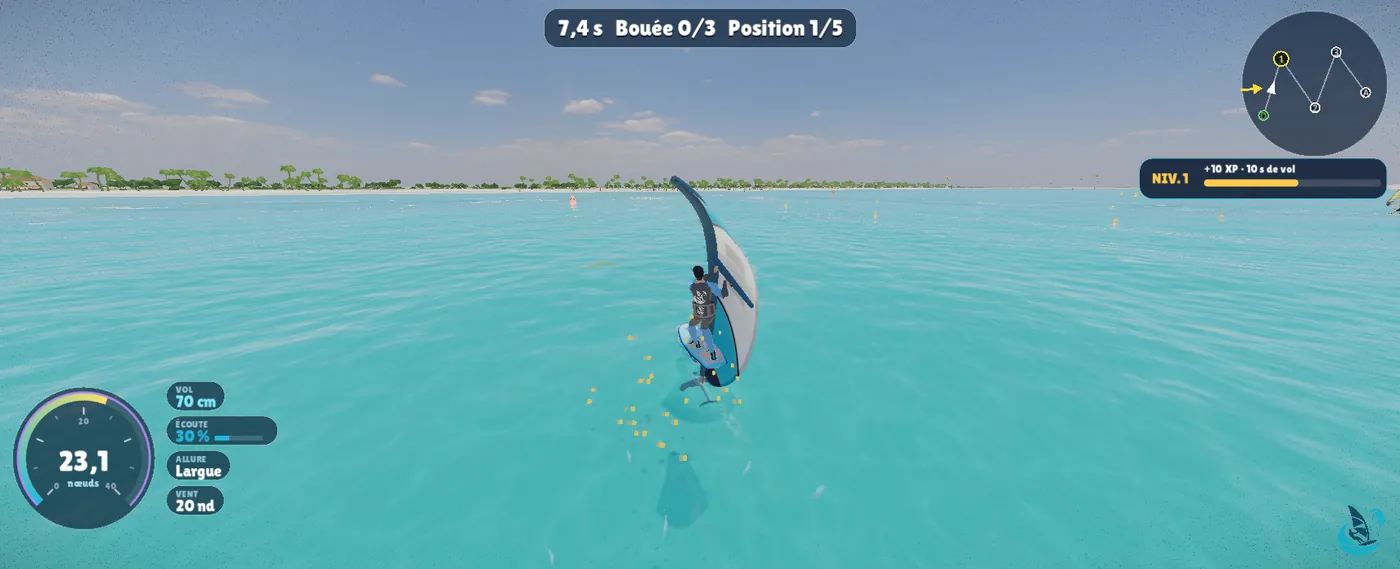
Waves that work as ramps
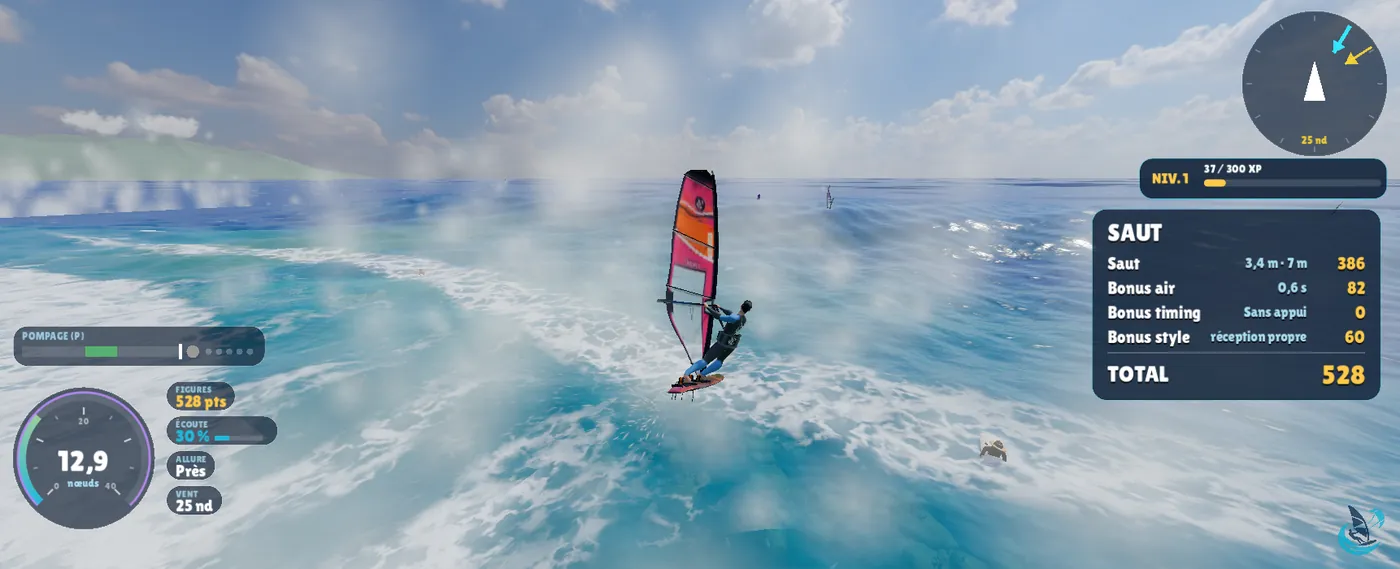
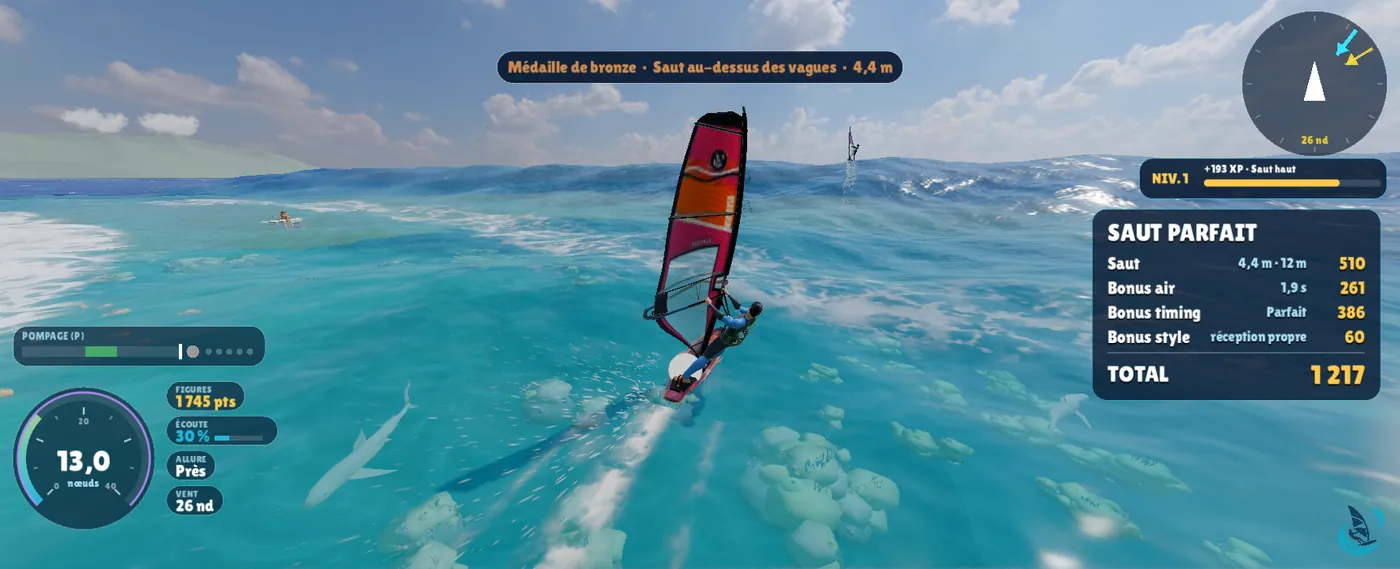
At Ho'okipa, the waves are now real ramps, in windsurf, wing and kite. The faster you hit the lip, the higher you go. Pressing Space at the right moment earns a bonus: "Perfect" within 0.15 seconds of the lip, "Good" within 0.32. A panel scores every jump: 100 points per metre of height, 6 per metre of length, a bonus for airtime, timing and style, and 60 points for a clean landing. In wing foiling, a measured perfect jump reaches 9.6 metres.
The start changed too: the beach start now takes a single key. The rider carries the gear from the sand into knee-deep water, you press Space, the foot goes on the board, the sail lifts the rider and off you go.
More believable riders
This was the longest piece of work, and the one where a sailor's eye matters most.
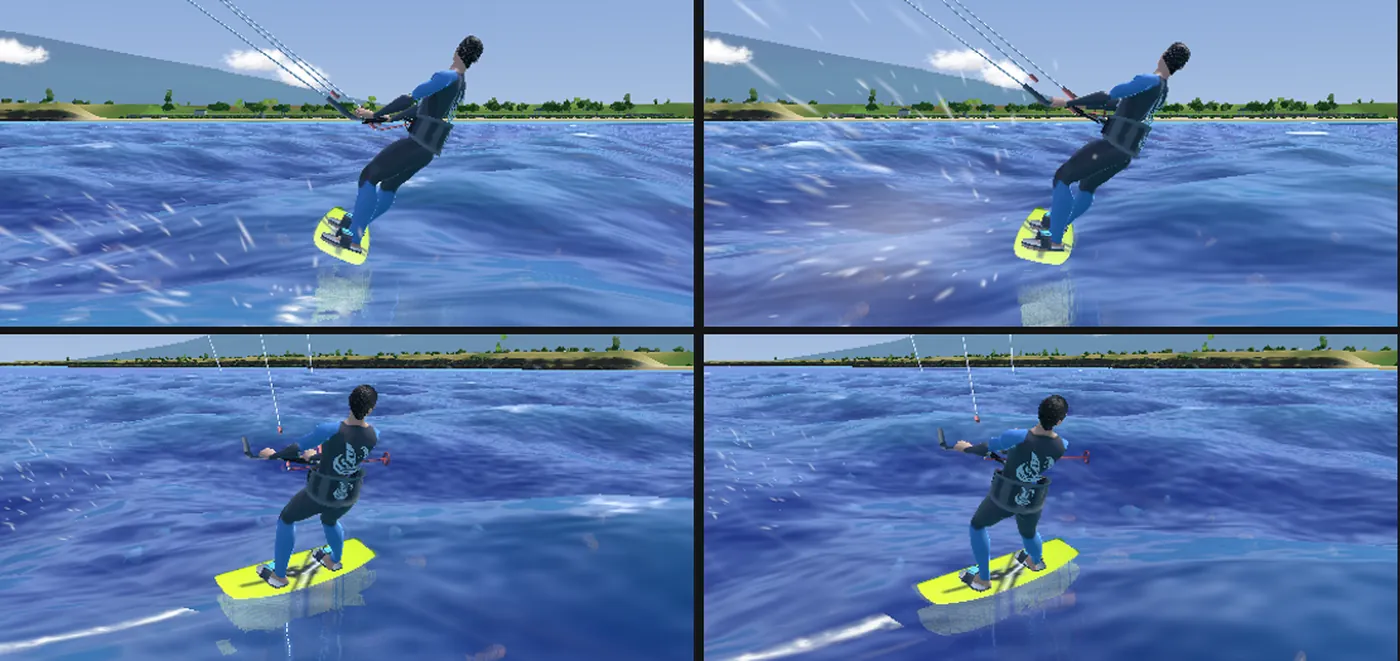
- The kite stance now follows a coaching sheet: front leg almost straight, back leg bent, weight on the back, shoulders open and the bar in front of the waist. Measured at 20 knots: the front knee went from 151 to 169°, and the weight on the back leg from 0.65 to 0.96 (0.5 = centred).
- Hands on the boom. The hands floated 15 cm above the tube, with broken wrists. Claude diagnosed it first: the boom that was drawn stayed at 1.35 m while the grips were computed at 1.50 m. Once the cause was found, the fix was simple: the grips follow the tube you see, recomputed every frame. Measured distance between palm and tube: 0.0 cm.
- The board in the water. Just before planing, it floated up to 2 cm above the water. Now it sinks in like a real board before it gets up on the plane.
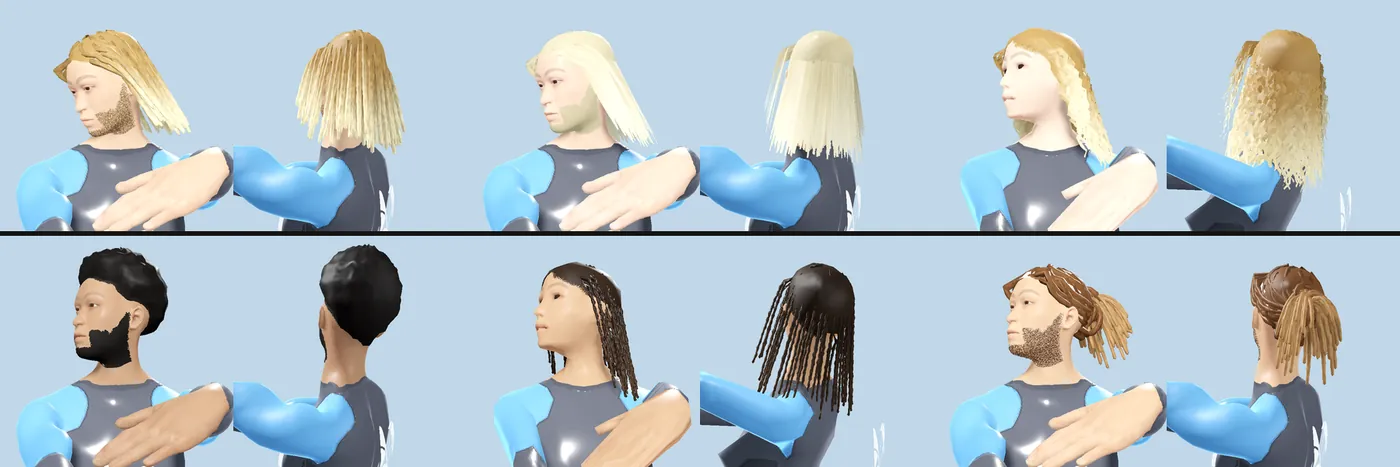
- Arms, wetsuit and skin: more muscular arms, a wetsuit with panels, seams, knee pads and a wet look on the water, tanned skin with real texture, and hair with highlights along the strands.
- Looks: dreadlocks, long straight or wavy hair, afro, braids, bun, shaved, stubble or short beard, headband, cap, beanie, seven hair colours and six skin tones. Each rival has their own, always the same one.
- Spray: real streaks of droplets, oriented by their speed, instead of white beads.
Sound without a single audio file
WindRush has no audio files at all: everything is synthesised in real time. This week brought wind in your ears (more turbulent on the windward side, muffled in the lee of the sail), board slaps synced with the board visibly dropping onto the chop, the hum of the foil and its cavitation above 19 knots, kite lines singing at full power, waves breaking around you, cheers from the beach at the finish and the timing beeps at La Palme. And it costs less than before: synthesis went from 1.70 to 0.38 ms per frame at La Palme.
Behind the scenes: how I work with Claude Code
Same duo as in the first article, but the method has matured.
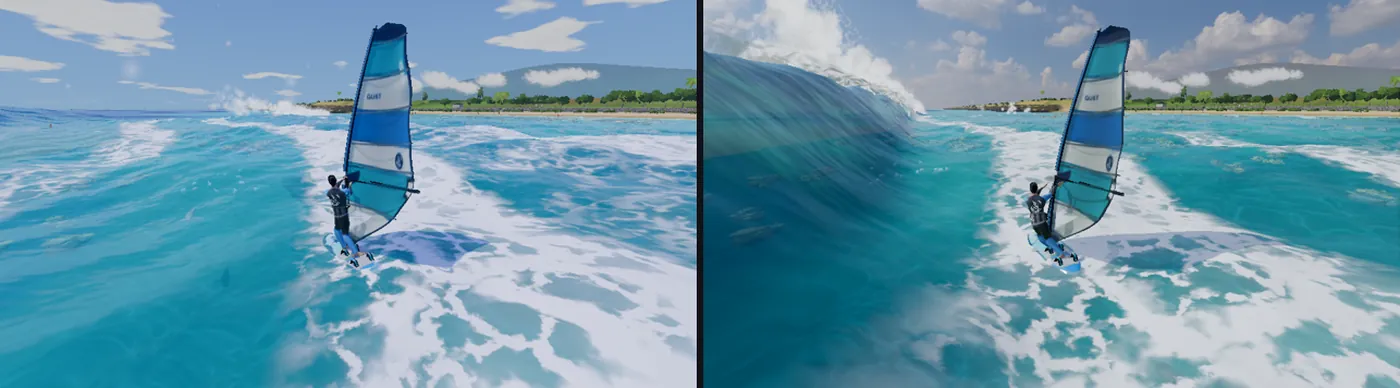
- Measure instead of guessing. A test scene, PoseTest, puts the rider in precise situations and checks numeric rules: a front knee of at least 165° when kiting, the palm less than 2 cm from the tube, the foot inside the strap. Every posture change goes through this check before it reaches the game.
- Diagnose before fixing. For the hands, Claude wrote the diagnosis before touching the code. That avoided "compensating" one bug with another.
- Before and after, in pictures. Every batch of work ends with a board of before and after screenshots from the same angle, which I review before signing off.
- Agents in parallel. For big jobs, Claude Code launches sub-agents that work at the same time: one reads the logs, another prepares screenshots, another writes the texts, like this article.
- Testing like a player, automatically. A quality sweep launched 115 automated game sessions (every discipline, every spot, the career and the lessons): no crashes, but it caught a real bug, a forced early start in the foil and wing races. It was fixed, then 39 sessions were run again without a single false start. The same sweep made the menus fully playable with a gamepad.
- A budget. Claude Code has a weekly usage limit: I plan the big jobs around it and keep ready-made lists for the following week.
I make the calls: the feel, the priorities and the references. I hand over my own posture photos and the kite coaching sheet, and I say when something looks "weird". The arms, for example, were redone twice before they looked right. And Claude cannot listen to the sounds: I am the one who judges the level of the wind and the slaps.
What still needs work
To be honest: up close, the character model is still basic (it would need a sculpted model with painted textures), some hairstyles like the afro or the bun still look like a block, and the beards look flat. The storm sky is less dramatic than the old painted one. And on integrated graphics, Ultra quality is still heavy: that is what light mode is for.
Next steps: remodel all the gear using 8,746 catalogue photos studied as references (real proportions of boards, kites, foils, wings and harnesses), new manoeuvres (tacking, uphauling the sail, the kneeling wing start, the kite waterstart) and a real race atmosphere: flags, a race village and spectators.
Download WindRush
WindRush is free for Windows PC at jstephan.itch.io/windrush, and also available as a direct download from www.windrush.fr. If you try it, tell me what you think: that is how I pick the next priorities.
I use the same approach (C#, .NET and AI as a copilot) on client projects: applications, platforms and games. See my custom software development service, or the case study of the FamiQuiz multiplayer game in .NET (in Spanish).
Got an app, platform or game project?
Let's talk: I'll propose the architecture, the timeline and a clear price.
Get my free quoteMessage me on WhatsApp